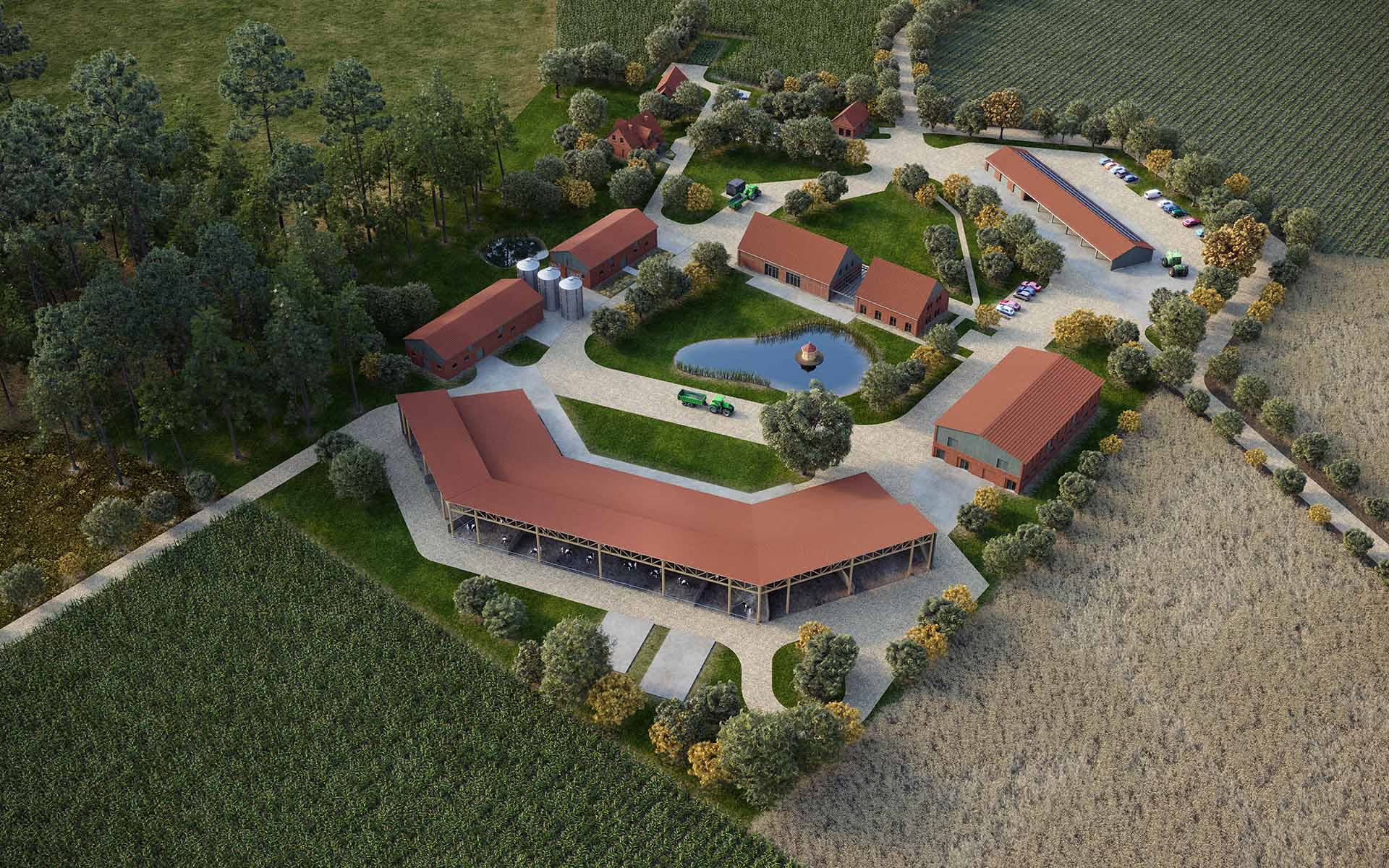
Folwark Trojanowo – an agricultural research and development project currently under construction.

This farm builds on agroecological knowledge and aims to become a regional and national pioneer and role model for regenerative farming practices.
Great things rarely happen overnight

What has already been created:

Although the commercial buildings, residential units, stables, and other infrastructure are still under construction, Folwark Trojanowo has already become an open-air research laboratory.
Specifically, strips of hedges were planted in the middle of a test field. These serve as windbreaks and provide shelter and food for birds, small mammals, and insects. The strips also retain more water and prevent soil erosion during heavy rain and drought.
Research into ground beetles as beneficial organisms for pest control is off to a successful start. They are intended to enable chemical-free cultivation, thereby ensuring an ecological balance on organic farms.

Future plans:

At the Folwark Trojanowo organic farm, we use responsible crop rotation to prevent soil depletion and maintain fertility. Soil rich in humus is also more resilient against drought and erosion.
Another key objective of the project is to increase biodiversity on the organic farm, across its land, and—wherever possible—in the surrounding area. Sustainable farming practices and the targeted creation of optimal habitats and conditions for insects, birds, small mammals, plants, and microorganisms are intended to help build a healthy ecosystem and preserve it for as long as possible.

Construction of the Folwark Trojanowo organic farm began in November 2025. This project aims to build bridges between practice, knowledge, and nature, serving as a space for research, learning, and discovery.

An open-air laboratory for sustainable agriculture and increased biodiversity

Test, research, and draw the right conclusions: Folward Trojanowo is a site for field research, supported by scientific analysis.
These research projects have successfully launched:

Soil Research

We analyze soil structure, fertility, carbon content, and the presence of soil organisms and microorganisms. These findings serve as the foundation for continuously improving soil quality over the long term.

Shelterbelts in the middle of fields

These non-agricultural strips divide the field, break the wind, and help the soil retain moisture for longer. In this way, they promote the development of healthy soil while simultaneously serving as habitats for plants and animals.

Ground beetles – natural allies in the fields

Ground beetles live in the soil and on crops. They are considered beneficial insects and are natural predators of pests that damage plants. Their presence contributes to the biological balance in fields and supports stable, sustainable farming systems.
Ausgewählte Artikel
15.7.2026
Schlaf im Einklang mit der Natur
Zum Artikel
15.7.2026
Konferenz „Biodiversität – Landschaft – Boden” im Hof der glücklichen Tiere
Zum Artikel
15.7.2026
Schafe im Dienst der Medizin: Ein Großtiermodell für die Erforschung menschlicher Krankheiten
Zum Artikel